Remember when a free game was a 2 GB download? In 2026, the big free-to-play releases weigh as much as premium AAA games, and their spec sheets keep repeating one line: SSD recommended. Why, and what it means for your rig.

Install sizes, from the spec sheets
| Game | Storage | SSD advice |
|---|---|---|
| Arknights: Endfield | 60 GB + 45 GB free to unpack | Strongly recommended |
| NTE: Neverness to Everness | 70 GB | Not specified |
| Zenless Zone Zero | 60 to 70 GB installed; up to 110 GB free during install | Advised |
| Rise of Kingdoms | 10 GB+ free | Not specified |
| Sea of Conquest | 10 GB free (reported) | Not specified |
| Project Entropy | 8 GB | Not specified |
| Raid: Shadow Legends | 5 GB (8 GB recommended) | Not specified |
Why big games want an SSD
Open-world and action games stream textures, maps and characters from your drive while you play. A hard drive reads data far more slowly than an SSD, so you get long loading screens, textures that pop in late and stutters when the game needs data fast. That is why Endfield's developers go out of their way to say "strongly recommended".
For small strategy and collection games, the difference is mostly shorter loading screens. Nice to have, not a deal breaker.
The free space trap
The size on the store page is not what the installer needs. Zenless Zone Zero's launcher can ask for up to 110 GB free during install, far above its final size. Endfield wants 45 GB extra to unpack. Games also grow with every update. Rule of thumb: keep at least as much free space as the game's size again, on top of the install.
512 GB, 1 TB or 2 TB?
- 512 GB: workable for Windows, a small active library and a tight budget. It fills quickly once you add one or two large live-service games.
- 1 TB: the sensible baseline for most PC gamers. It leaves room for Windows and several current games without forcing weekly uninstall-and-reinstall cycles.
- 2 TB: the comfortable choice if you keep several open-world games installed, use mods, record gameplay or share the PC.
Capacity is not the same as usable game space. Reserve room for Windows, launchers, shader caches, recordings and updates. A drive that is permanently full turns every large patch into a storage emergency.
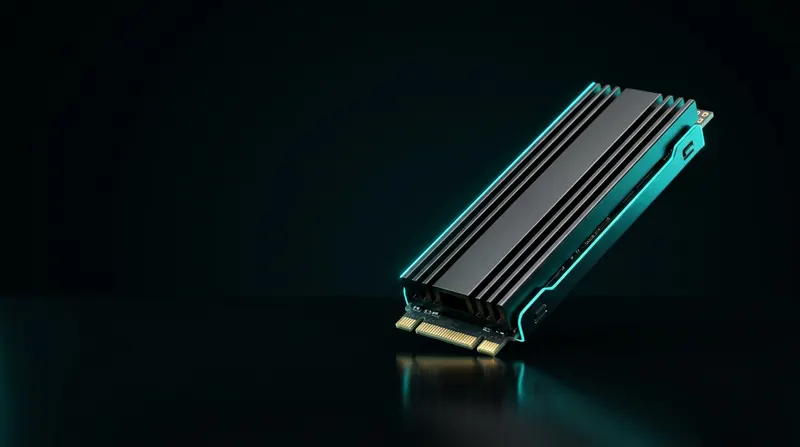
For a new desktop, an NVMe M.2 SSD is often the cleanest option when the motherboard supports it. A SATA SSD is still a perfectly sensible game drive if it is cheaper or your system has no spare M.2 slot. Check the exact motherboard or laptop model before buying: NVMe and SATA M.2 drives are not automatically interchangeable.
How to check your drive
- Press Ctrl + Shift + Esc to open Task Manager.
- Open the Performance tab.
- Click each Disk: Windows shows SSD or HDD.
Then open File Explorer, click This PC and check the free space under each drive. Full walkthrough for every spec: Can your PC run it?
Have both? Split them
If your PC has an SSD and a hard drive, put the big games (Endfield, NTE, ZZZ) on the SSD and keep lighter games, videos and downloads on the HDD. Most launchers let you choose the install folder.
Sizes and SSD advice come from official sources, linked in each game guide. We have not measured loading times ourselves yet and do not recommend a specific drive until we have.
Bottom line
For the heavy hitters, Endfield and ZZZ officially, and NTE by sheer size, an SSD is not optional in spirit, and you need way more free space than the store page suggests. For Raid, Project Entropy or Sea of Conquest, a hard drive does the job. Pair your SSD with enough memory too: 16 GB vs 32 GB RAM.
Other major free games and their storage needs
| Game | Install size | SSD needed? |
|---|---|---|
| Counter-Strike 2 | ~30 GB | Recommended |
| Valorant | ~25 GB | Recommended |
| Apex Legends | ~60 GB | Strongly recommended |
| Fortnite | ~30 GB | Recommended |
| Genshin Impact | ~80 GB | Strongly recommended |
| Warframe | ~50 GB | Recommended |
| Destiny 2 | ~100 GB | Required |
| Path of Exile | ~40 GB | Recommended |
| Lost Ark | ~80 GB | Strongly recommended |
| Dota 2 | ~35 GB | Nice to have |
Total for all ten: over 500 GB. This is why storage management matters for free-to-play gamers.
NVMe versus SATA SSD
Not all SSDs are equal. Two main types exist on the market:
- SATA SSD: Connects via SATA cable (same as HDD). Read speeds around 500 MB/s. A massive upgrade from HDD (100 MB/s) but not the fastest available.
- NVMe SSD: Connects via M.2 slot directly on the motherboard. Read speeds from 2,000 to 7,000 MB/s. Reduces loading times further in games that stream large assets.
For most free-to-play games, a SATA SSD is enough. NVMe helps in open-world games (Genshin, NTE, Lost Ark) where the world loads around you as you move.
Managing storage across multiple games
With free-to-play games reaching 60-100 GB each, a 500 GB SSD fills up fast. Strategies:
- Keep two or three active games on SSD. Move games you are not currently playing to HDD or uninstall them.
- Steam library folders: Steam lets you create libraries on different drives. Move a game between SSD and HDD without reinstalling: right-click the game > Properties > Local Files > Move Install Folder.
- Epic Games Store: Requires manual copy and "verify" to move between drives.
- Symbolic links: For launchers that do not support multiple libraries, create a symbolic link from the HDD install folder to the SSD. Windows command:
mklink /D "D:\Games\GameName" "C:\SSD\Games\GameName".
When to upgrade
| Your current setup | Recommendation |
|---|---|
| HDD only, 8 GB RAM | Add a 500 GB SATA SSD (~$30-40) as boot + game drive |
| 256 GB SSD + HDD | Keep the OS and 2-3 active games on SSD, store the rest on HDD |
| 500 GB SSD only | Sufficient for 4-5 large games. Add a second drive if you play more |
| 1 TB+ NVMe | No storage bottleneck for any free-to-play game |
A 500 GB SATA SSD is the single best upgrade for a gaming PC that still runs on HDD. It improves loading times more than any other component upgrade at the same price.
More free game guides
The complete free PC games guide covers every genre and platform.
FAQ
Can I install a free PC game on a hard drive?
How much free space should I keep?
How do I know if my drive is an SSD?
Which free games are fine on a hard drive?
// Sources